Apple’s AI Advantage: Privacy Meets Performance
For years, the AI story was simple: bigger models, bigger data centers. Most companies run powerful AI in the cloud and send user data to those servers. Apple is changing that script. With Apple Intelligence, it’s pushing much of the AI work onto your iPhone, iPad, and Mac — keeping private things private, while still delivering useful AI features. That is an important turn because privacy, speed, and seamless experience suddenly matter as much as raw power
So, what does Apple Intelligence actually do?
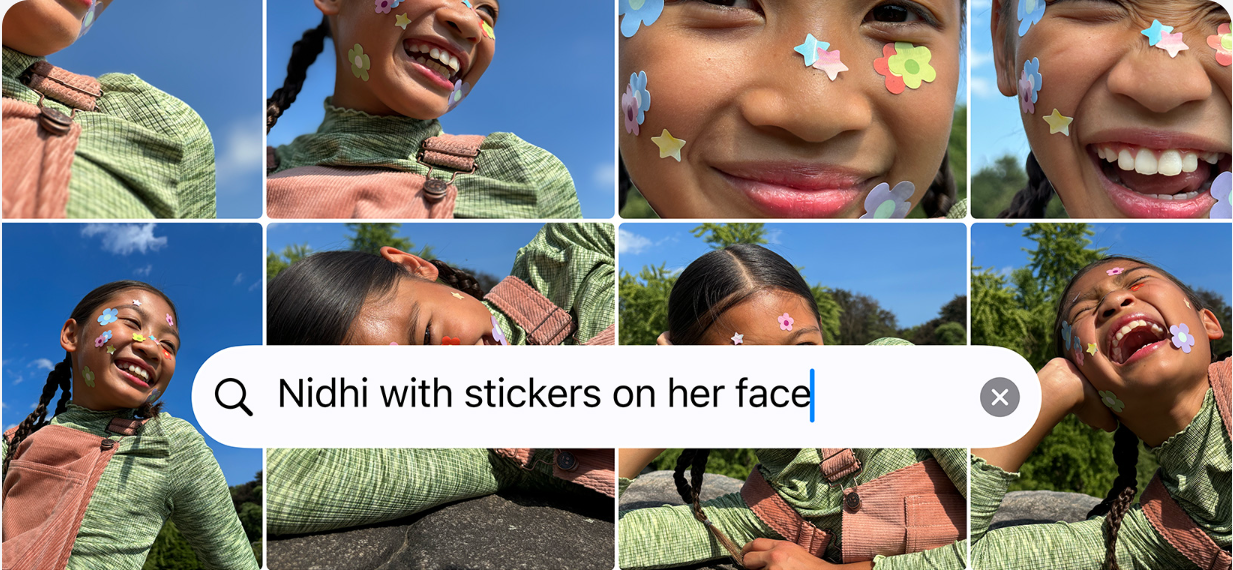
Apple Intelligence weaves AI into everyday tasks. It helps rewrite emails, summarize message threads, find photos by asking in natural language, and prioritize the notifications you truly care about. Siri gets smarter, not just answering questions, but acting on context inside your apps. Some tasks are handled directly on the device; heavier ones are handled via Apple’s Private Cloud Compute (more on that below). The user experience is meant to feel like a helpful assistant that lives on your device, not in someone else’s server room.
Features like Writing Tools, clean-up for photos, smart summary of mail/messages and natural-language search in photos work directly on device — meaning users get instant results without uploading personal data to the cloud.
Let us see examples to get an idea of why this Apple move can be a game-changer!
Imagine you return from a meeting and your Messages thread has 200 responses. Instead of scrolling, you ask: “Summarize the key decisions from this thread.” Apple Intelligence reads the thread and returns three bullets: what was decided, who is responsible, and what’s due next. For email, it can rewrite a long draft in your tone, or suggest a short reply if you’re on the go. This saves time and reduces mistakes. Isn't that great? And you don't even need any extra software for this!
Imagine again! You want to search for an image that is long lost in your endless phone gallery. Instead of scrolling the whole day, you ask: “Show me photos of Emily at the beach with a red hat.” Apple Intelligence scans your Photos library on-device, finds the matches, and ranks them by relevance. If you want a collage for a birthday post, say “Create a 6-photo collage with these images and add a warm filter,” and it prepares one using only images on your device. Nothing has to leave your phone for the AI to work.
Still not convinced? What about this!
Siri can no longer just do simpler tasks. No! It has a greater purpose to serve now! Imagine you say: “Siri, prepare a summary of the attachments from today’s emails and highlight anything asking for a follow-up.” Siri reads the files, finds the ask-for-action items, and builds a checklist — all while preserving privacy settings. It’s like having a PA who remembers the context inside your apps.
If you are still not getting the genius behind Apple's intelligence, imagine this last piece of magic.
You are on a train, there is no network, you can barely make calls, guess what, your apple device doesn't care. It can still summarize notes or draft a message because Apple Intelligence features run entirely on-device. That’s useful when you’re offline, traveling, or in low-connectivity areas.
I cannot convince you more! We are not marketing Apple here!
If you like, I can gather 3–5 third-party statistics or survey-data (about user privacy concerns, demand for on-device AI, market numbers) to support your narrative — that tends to add extra depth.
Let's discuss the tech and infrastructure now!
Apple uses a two-part system: on-device models + Private Cloud Compute.
On-device models: These are smaller, optimized AIs that run on iPhone and Mac chips. They handle most everyday tasks — reading messages, editing photos, rewriting text. Because they run locally, your data doesn’t leave your device.
Private Cloud Compute (PCC): Some tasks are heavier (long video edits, large multimodal jobs, or big dataset processing). For those, the device creates a short, private session on Apple’s servers, but with two safeguards. First, the session runs on Apple Silicon servers, and second, the code and results are ephemeral (they aren’t stored long-term). Think of PCC as borrowing extra brain for a minute, doing the heavy work, then deleting the borrowed workbench.
This hybrid approach hits three big user needs. First, privacy: most processing stays on your device. Second, speed: on-device responses are instantaneous and don’t depend on network lag. Third, personalization: the device can learn your preferences locally (how you write, which photos you like), so recommendations feel personal without exposing your data broadly.
If you have read it so far, you must be wondering how Apple can do all this while others can't( well, I mean, not close to Apple's level of perfection and privacy).
This strategy is possible because Apple controls both hardware and software. Apple Silicon chips (A-series and M-series) are optimized for efficient AI tasks. They can run these models with reasonable battery and thermal profiles. That’s the reason on-device AI now works well: the phone or laptop has enough muscle to do serious work without draining the battery or getting painfully slow.
Now this is different from cloud-first AI, which is used by most of the other smartphone and laptop companies.
Cloud-first models are extremely powerful and can do mind-bending tasks, but they depend on sending data off your device and often have latency and privacy trade-offs. Apple’s approach is about shrinking the model intelligently and combining it with short, private server sessions for the heavy lifting. If cloud models are a supercomputer you log into, Apple’s model is more like having a capable local workstation and renting a supercomputer only when you absolutely need it.
This strategy is fundamentally reshaping how the biggest tech companies position themselves in the AI race. While Google and OpenAI continue to double down on cloud-first AI models and massive developer ecosystems, Apple is choosing a very different path: deeply personal, privacy-first intelligence that lives on the device. Samsung, meanwhile, is aligning closely with Google’s cloud ecosystem through Galaxy AI, offering hybrid on-device + cloud features, but still leaning heavily on Google’s model infrastructure. Other hardware players like Xiaomi and Oppo are pushing AI-enhanced features too, but none have Apple’s level of tight hardware–software integration.
A 2024 survey found that 53% of consumers are aware of privacy laws, and among them, 81% feel more confident about protecting their data when they understand how privacy works.
That’s where the real competitive difference emerges. Apple wants users to experience AI that feels built just for them, running privately and instantly on their own hardware. Samsung and the Android ecosystem are racing to offer similar experiences, but their dependence on third-party AI models creates a different dynamic. For users who prioritize privacy and a seamless, closed-loop system, Apple’s approach could build unmatched loyalty. For those who value flexibility, open ecosystems, and cutting-edge cloud capabilities, Samsung, Google, and other Android partners will remain compelling options. The battleground is no longer just about who has the most powerful model. It’s about who users trust to handle their data and who delivers the smoothest day-to-day experience.
I guess we have delivered the message we wanted to. Apple AI is not a joke anymore, and the talk is not only about privacy, but it's also about its endless features and new generation capabilities.
Keep an eye on three things: how fast Apple rolls features to older devices, whether third-party apps can deeply integrate Apple Intelligence, and how competitors respond. If Apple proves that meaningful AI can live on-device without compromising quality, other companies may rush to adopt similar hybrid models.
If that’s very, very clear to you, the next major shift in AI might not be about who owns the largest model; It will be about who gives users the smartest, fastest, and most private experience.
See you in our next article!
If this article helped you explore and understand the Runway tool, check out our recent stories on Runway AI, Lovable 2.0, MAI-IMAGE 1, Assembly AI, and Dialogue AI. Share this with a friend who’s curious about where AI is heading next. Until next brew ☕